Visitors arriving in Cambridge for the first time are often surprised to discover that one of England's most famous historic cities does not have a cathedral.
With its magnificent architecture, centuries of academic tradition and breathtaking chapels, Cambridge certainly looks like a city that should be home to one. In fact, many guests strolling through the city centre assume that the iconic silhouette of King's College Chapel must be Cambridge Cathedral.
Yet, Cambridge has never had a cathedral of its own.
The story behind this is a fascinating glimpse into the city's history and, perhaps more importantly, an opportunity to discover some of the remarkable churches and chapels that make Cambridge such a rewarding destination for visitors today.
Why Doesn't Cambridge Have a Cathedral?
A cathedral is not simply a large or impressive church. It is the principal church of a diocese and serves as the seat of a bishop.
For more than 900 years, Cambridge has fallen within the Diocese of Ely, meaning the region's cathedral was established at Ely rather than in Cambridge itself. When the Diocese of Ely was created in 1109, Ely became the religious centre for the surrounding area, while Cambridge continued to develop as a thriving market town and, later, as one of the world's leading university cities.
As the University of Cambridge expanded, the colleges built their own chapels and places of worship. Rather than one dominant cathedral, the city evolved into a collection of extraordinary churches and college chapels, each with its own unique story.
Today, this gives Cambridge a distinctive character unlike any other city in England.
King's College Chapel: The Building Everyone Mistakes for a Cathedral
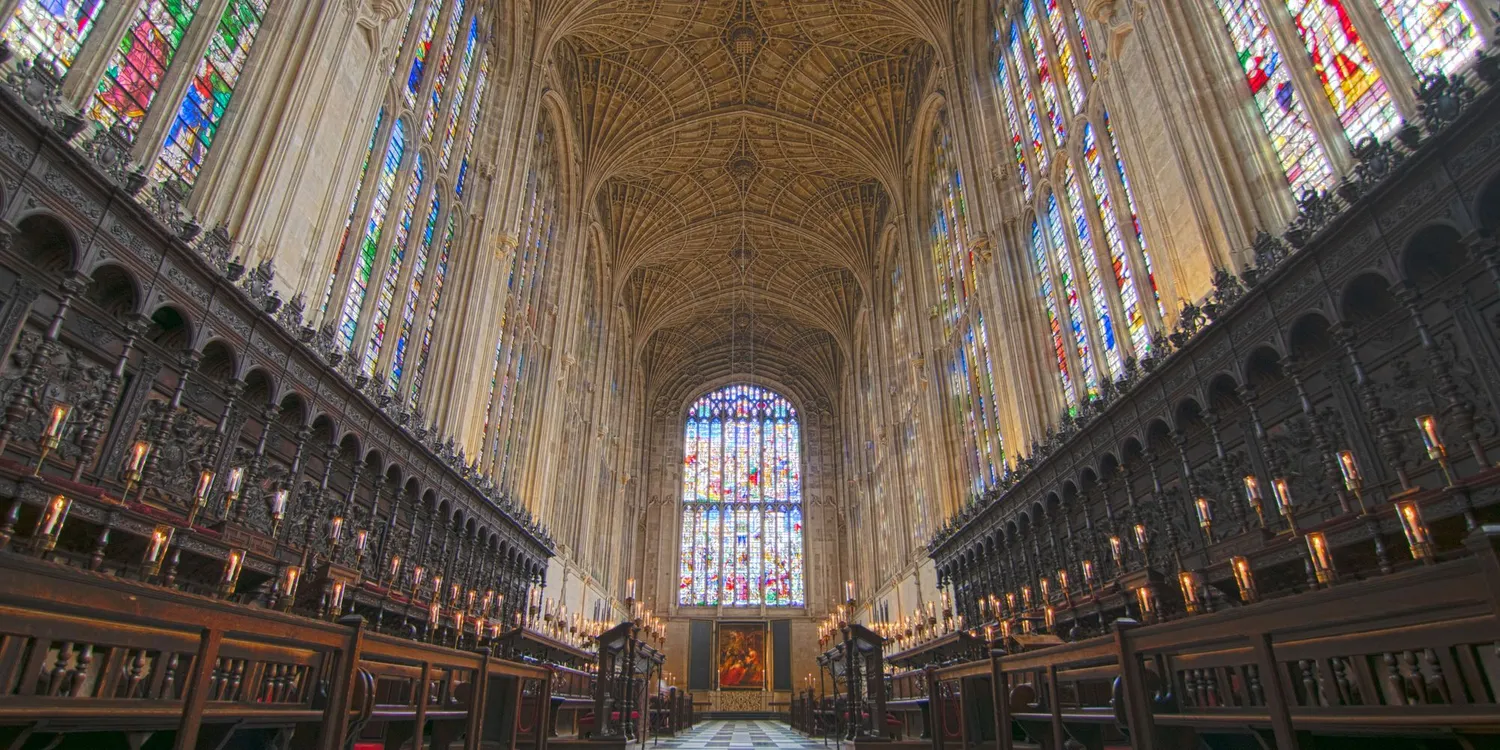
No visit to Cambridge is complete without stepping inside King's College Chapel.
Commissioned by Henry VI in 1446, this masterpiece of Late Perpendicular Gothic architecture took over a century to complete, it’s construction didn't finally conclude until 1547, meaning it outlasted the reign of every monarch who began it. Its soaring fan vaulted ceiling remains the largest in the world, and the vast windows contain the most complete set of original medieval stained glass anywhere in England.
The chapel is perhaps best known internationally for the annual
broadcast every Christmas Eve and listened to by millions. What fewer visitors realise is that the service was only introduced in 1918, and the famous procession of candlelight that television audiences recognise was not added until 1930.Although it is not a cathedral, King's College Chapel possesses a grandeur and atmosphere that rivals many of Europe's great religious buildings. For many visitors, it becomes the highlight of their time in Cambridge.
Great St Mary's: The Heart of University Cambridge
Located in the centre of the city opposite the Senate House, Great St Mary's is known as the University Church.
For centuries it has played an important role in the life of Cambridge, hosting university sermons, ceremonies and special events. One of its lesser-known distinctions is that the chime of its bells became the template for Big Ben, the Westminster Quarters tune was adapted directly from a peal composed for Great St Mary's in 1793.
The church's elegant tower also offers one of the finest viewpoints in the city. Guests willing to climb the narrow staircase are rewarded with spectacular views across Cambridge's famous rooftops, college courts and chapel spires. On a clear day, it is one of the best places to appreciate the city's unique architectural beauty.
St Bene't's Church: Cambridge's Oldest Building
Just a short walk from the city centre stands and the University Arms, one of Cambridge's most remarkable hidden gems.
St Bene't's Church is home to the oldest surviving structure in Cambridge, an Anglo-Saxon tower dating from before the Norman Conquest of 1066. Look closely at the tower's upper windows and you will notice the distinctive long-and-short stonework and the carved stone animals flanking the arch, and features typical of late Saxon craftsmanship that have survived virtually intact for nearly a thousand years.
The church has long standing ties to Corpus Christi College next door, which used it as its chapel for several centuries before the college built its own. Its peaceful atmosphere offers a striking contrast to the bustle of nearby college streets and provides visitors with a rare connection to Cambridge's earliest history.
The Round Church: A Rare Architectural Treasure
Among Cambridge's many historic churches, none is more distinctive than the Round Church.
Built around 1130, it is one of only four medieval round churches remaining in England. Inspired by the Church of the Holy Sepulchre in Jerusalem, its circular design immediately sets it apart from traditional English churches. The building is thought to have been constructed by a fraternity of crusaders returning from the Holy Land, though the exact patrons remain a matter of historical debate, which only adds to its intrigue.
The building is both an architectural curiosity and an important part of Cambridge's medieval story, making it a fascinating stop during a leisurely walk through the city.
The Hidden Gems: University Arms Concierge, Insider's Guide to Cambridge's College Chapels
At University Arms, we believe that the most rewarding experiences in Cambridge are rarely the ones you stumble upon by accident. The city's college chapels are a perfect example. Beyond King's College Chapel, magnificent as it is, lies a constellation of smaller, quieter, and in many ways more surprising places of worship, each carrying centuries of stories that most visitors never hear.
Here is our guide to the chapels that reward the genuinely curious.
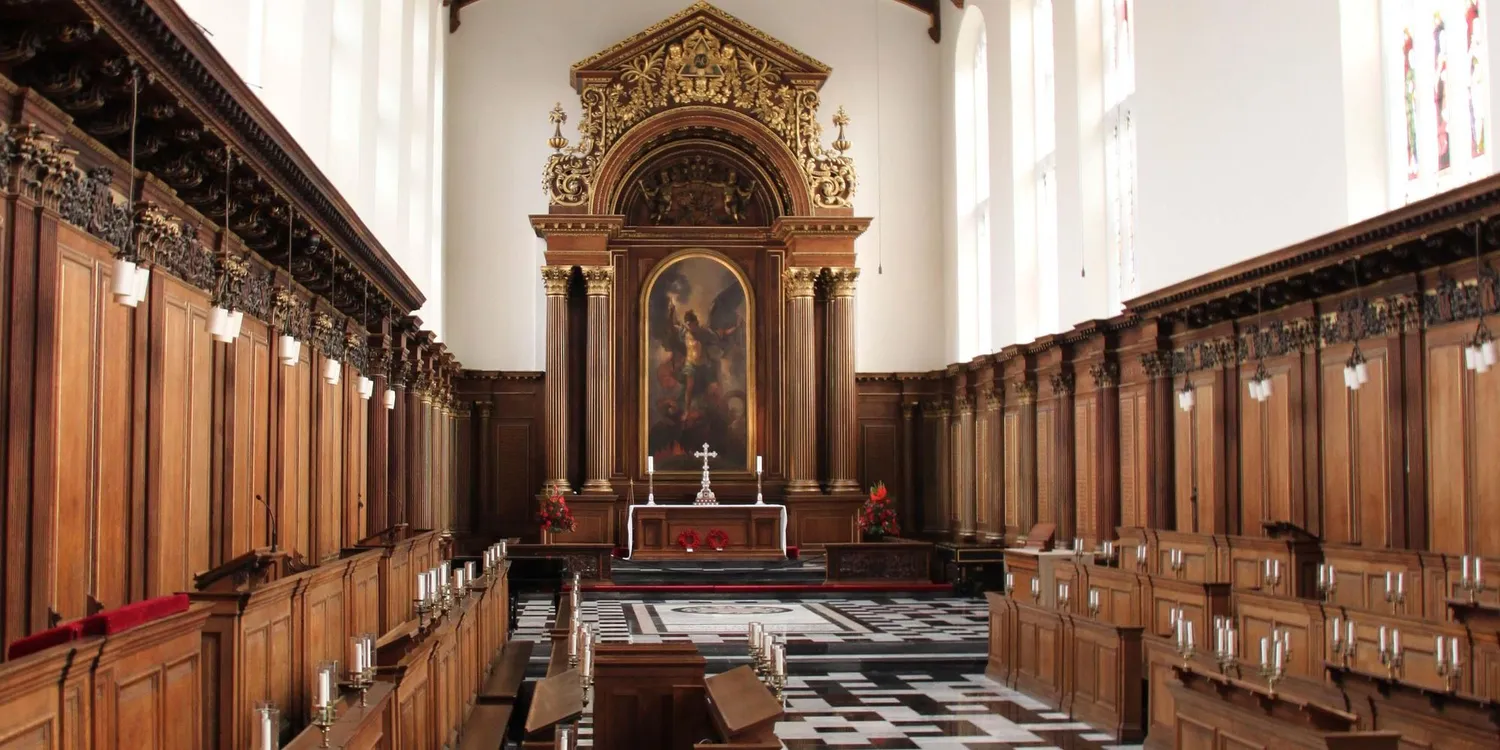
Pembroke College Chapel holds a distinction that stops many visitors in their tracks: it was the very first building completed by Sir Christopher Wren. Finished in 1665, it was commissioned not by the college but by Wren's uncle, Matthew Wren, Bishop of Ely, who had spent eighteen years imprisoned in the Tower of London during the Civil War and had made a solemn vow to build a chapel upon his release. The result is an elegant, restrained baroque building that offers a fascinating glimpse of Wren's emerging genius, conceived before he had ever designed a church in London, and long before St Paul's Cathedral made him famous.
Emmanuel College Chapelknown to everyone in Cambridge simply as "Emma", was also designed by Wren, completed in 1677 on the site of a former Dominican friary. Its most quietly extraordinary detail is a stained glass window commemorating John Harvard, who studied here before emigrating to America and leaving his library and half his estate to found what became Harvard University. It is one of those moments where Cambridge's reach across history suddenly feels very tangible.
Jesus College Chapel is, in our view, one of the most underappreciated buildings in the entire city. Parts of it date to the twelfth century, when the site was a Benedictine nunnery, making it the oldest college largely intact medieval college chapel in Cambridge. What makes it truly special is what happened during its Victorian restoration: William Morris, Edward Burne-Jones and Ford Madox Brown were all brought in to contribute stained glass and decorative work. The result is an unexpected and utterly beautiful showcase of Arts and Crafts design, hiding in plain sight behind the college's famous red-brick gatehouse.
Clare College Chapel is the one we tend to recommend to guests who want something a little quieter and more contemplative. Completed in 1769, it has a beautifully proportioned neoclassical interior that feels genuinely intimate, a world away from the grandeur of King's. Clare has a distinguished choral tradition and because it draws fewer visitors than its more famous neighbours, it rewards those who seek it out with a rare sense of stillness at the heart of the city.
St John's College Chapel forms part of one of Cambridge's most picturesque riverside settings. The Victorian chapel, completed in 1869, was designed with its acoustics in careful consideration to support one of the finest college choirs in the world. The antechapel contains monuments to notable alumni including William Wordsworth, who studied at St John's and is said to have walked the college's famous
by night to compose his verse.Trinity College Chapel reflects the enormous prestige of Cambridge's largest college. It contains a marble statue of Sir Isaac Newton by Louis-François Roubiliac, widely considered one of the finest portrait sculptures in England, alongside memorials to Francis Bacon, Lord Tennyson and other remarkable alumni. A lesser-known detail: the chapel's organ was played by a young Orlando Gibbons, one of the great composers of the Tudor age, who was a chorister at King's before moving to Trinity.
Gonville & Caius College Chapel is small and easy to overlook, tucked within one of the most architecturally layered college courts in Cambridge. But for those who know the city well, it carries a particular weight, it was here, in 2018, that Stephen Hawking's memorial service was held. It is a quiet, unassuming space with a connection to one of the greatest minds of the twentieth century.
Selwyn College Chapel tends to be missed by visitors who don't venture beyond the historic city centre, and that is precisely why we mention it. A handsome Gothic Revival building completed in 1895, it is acoustically exceptional and home to a choir that punches well above its weight. For guests who have already experienced evensong at King's or St John's and want to discover where Cambridge's living choral tradition extends beyond the famous names, Selwyn is the answer.
Christ's College Chapel retains an intimate atmosphere that feels remarkably unchanged from the era of its most famous student. John Milton studied at Christ's from 1625, and a mulberry tree in the college garden is traditionally said to have been planted by him. The chapel sits at the heart of one of the city's most peaceful college gardens — a place worth seeking out for its quietness alone.
Queens' College Chapel rewards the observant visitor with one of Cambridge's most charming architectural illusions. Its wooden ceiling is painted to give the convincing impression of elaborate fan vaulting, a trompe l'oeil that catches even experienced visitors off guard. It is the kind of detail that, once seen, becomes one of those small Cambridge discoveries you find yourself mentioning for years afterwards.
The Insider’s, Insider titbit: The Chapel That Predates Them All
If the college chapels represent Cambridge at its most scholarly and refined, then the
of St Mary Magdalene on Newmarket Road, represents something altogether older and more elemental.Built around 1125, it actually predates the University itself, making it the oldest complete building in the entire Cambridge area, older even than the Anglo-Saxon tower at St Bene't's. It was constructed to serve a leper hospital, positioned deliberately outside the medieval town boundary so that those with leprosy could participate in religious life without entering the city. That it survives virtually intact, its Norman architecture almost entirely unaltered after nine centuries, is quietly astonishing.
It sits a short distance from the city centre and receives a fraction of the visitors that the college chapels do, which only adds to its atmosphere. Stepping inside feels less like a tourist experience and more like a genuine encounter with medieval Cambridge. The Cambridge that existed long before the first college was founded, when this was a market town on the edge of the fens.
The chapel also stands on the site of the ancient
once the largest trading fair in Europe, drawing merchants from across the continent every September. John Bunyan is said to have visited and drawn on the scene when writing The Pilgrim's Progress,one of those details that makes Cambridge's history feel almost impossibly layered.For explorers who have explored the colleges and want to find something truly off the beaten track, this is our most unexpected recommendation.
Where Is the Nearest Cathedral to Cambridge?
For visitors keen to experience a cathedral during their stay, several exceptional examples can be reached easily from Cambridge.
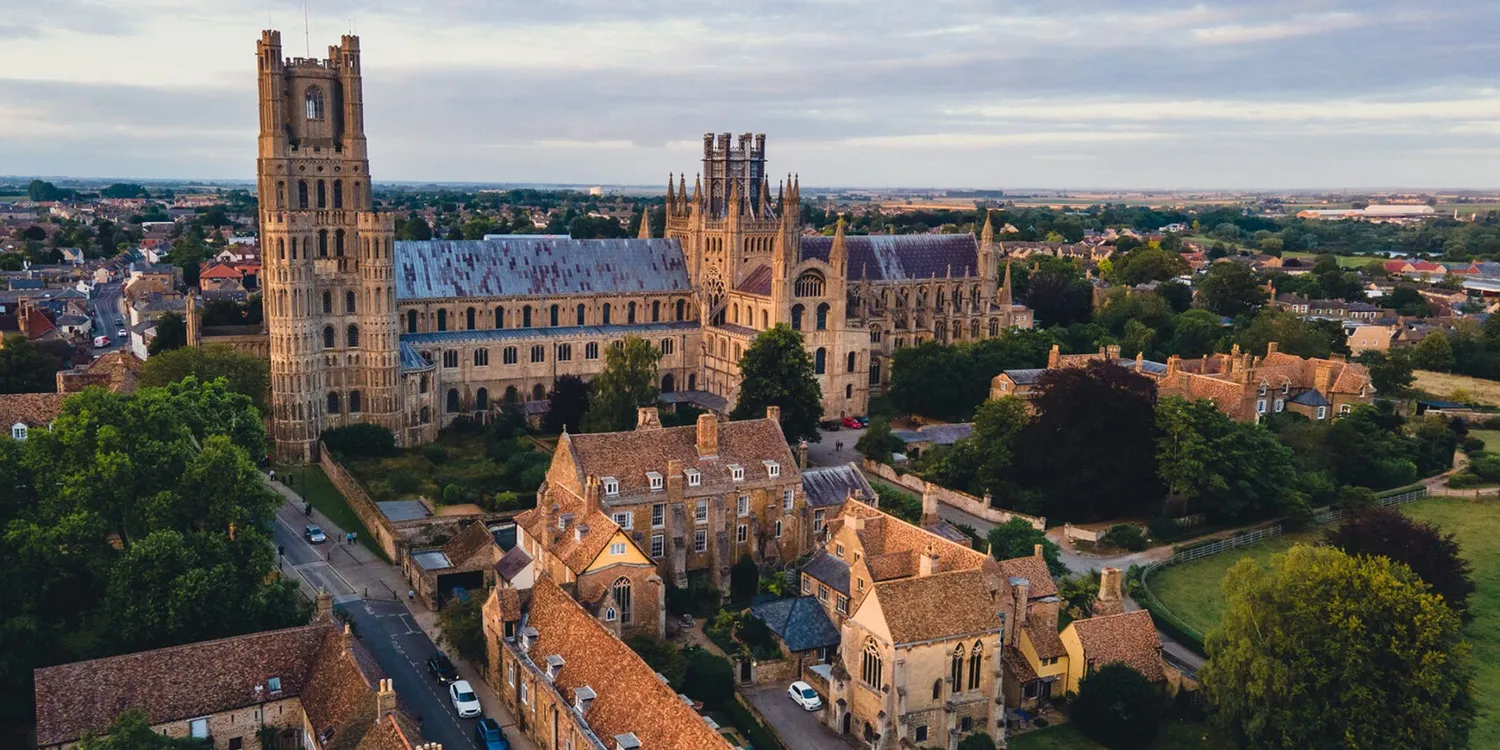
Ely Cathedral just 15 miles north of Cambridge, is the closest and most spectacular option. Often referred to as the "Ship of the Fens", its magnificent profile rises above the flat surrounding landscape from miles away. Dating back to the early medieval period, Ely is renowned for its extraordinary Octagon Tower, an engineering marvel of the fourteenth century built to replace a Norman crossing tower that collapsed in 1322. Whether reached by car, train or guided excursion, Ely makes an excellent half-day trip.
Peterborough Cathedral, approximately an hour from Cambridge, is one of England's finest Norman cathedrals. Its dramatic west front and rich royal history. Catherine of Aragon is buried here, make it a rewarding destination for visitors interested in architecture and heritage.
St Edmundsbury Cathedral in Bury St Edmunds combines medieval history with more recent architectural additions, including a striking tower completed in the twenty-first century. A visit can easily be combined with exploring the town's historic streets, gardens and independent shops.
A Different Kind of Religious Heritage
Cambridge may not have a cathedral, but that is part of what makes the city so distinctive.
Rather than being defined by a single grand religious building, Cambridge's story is told through its remarkable collection of churches, chapels and college foundations — each with centuries of history, unexpected connections and quiet stories waiting to be discovered.
For guests staying at University Arms and exploring the city, this means there is always something new to find: the world's largest fan vault at King's, Christopher Wren's debut building at Pembroke, a John Harvard memorial at Emmanuel, or Saxon stonework that predates the Conquest at St Bene't's.
It is a reminder that some of England's most extraordinary religious buildings are found not in cathedrals, but woven into the everyday fabric of Cambridge itself.
Frequently Asked Questions:
Can visitors enter the college chapels?
Many of Cambridge's college chapels are open to visitors during certain hours, though access varies by college and time of year. King's College Chapel charges an admission fee and is one of the most reliably accessible. Pembroke and Emmanuel chapels are often open during the day and are free to enter. It is always worth checking the individual college's website before visiting, as chapels may close during exam periods or private services. Choral evensong — free to attend at King's and St John's on most term-time evenings — is one of the finest experiences Cambridge has to offer.
Which Cambridge college chapel is the oldest?
St Bene't's Church, technically a parish church rather than a college chapel, contains Cambridge's oldest structure in its Anglo-Saxon tower, dating from before 1066. Among the college chapels specifically, the medieval chapel of St John's College has its origins in the thirteenth century, though the current Victorian building replaced it in 1869. Peterhouse, Cambridge's oldest college, retains significant elements of its fourteenth-century chapel, making it among the earliest surviving purpose-built college chapels in the city.
Is there anywhere to hear choral music in Cambridge's chapels?
Cambridge has one of the richest choral traditions anywhere in the world. Choral evensong is sung regularly during university term time at King's College Chapel, St John's College Chapel, and at Great St Mary's. King's is particularly famous for its choir of boys and male choral scholars, a tradition stretching back over five centuries. Attending a free evensong service is widely regarded as one of the most memorable things a visitor can do in Cambridge — no booking is required, and the music is simply extraordinary.